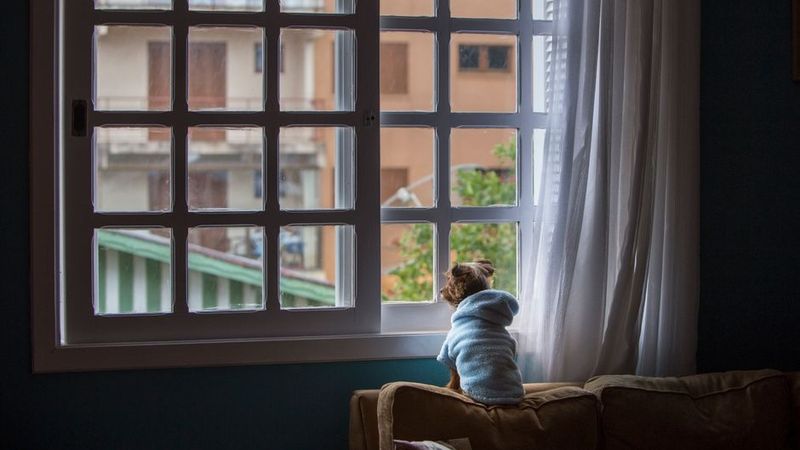
Some dogs settle the moment the door closes behind their owner. Others start pacing, whining, or scratching at the exit within minutes. The difference often comes down to how gradually a dog learned that being alone is safe and temporary, rather than something fixed or unchangeable about the individual dog.
This guide covers a gradual conditioning process for a dog that gets uneasy when left alone, built around short, successful absences rather than long ones that end in distress. It also draws a clear line: mild restlessness responds well to home practice, but panic-level separation anxiety, marked by destruction, self-injury, or extreme and prolonged distress, needs a veterinary behaviorist, not just a longer version of the exercises below.
Mild Restlessness vs. Panic-Level Separation Anxiety
Not every dog that whines when left alone has separation anxiety in the clinical sense. Telling the two apart matters, because the approach that helps mild restlessness can be too much, too fast, for a dog in genuine panic.
| Sign | Mild restlessness | Panic-level separation anxiety |
|---|---|---|
| Vocalizing | Brief whining or barking that settles within a few minutes | Prolonged, escalating howling or barking that doesn't taper off |
| Physical signs | Some pacing early on, then settles | Heavy panting, drooling, trembling throughout the absence |
| Property | No damage, or minor chewing on a toy | Destruction near doors and windows, sometimes with injury to teeth or paws |
| Bathroom accidents | Rare, mostly tied to bladder timing | Frequent, despite being otherwise house-trained |
If a dog consistently shows the signs in the right-hand column, gradual home conditioning alone is unlikely to be enough, and a veterinary behaviorist should be involved before or alongside any training plan, since panic-level anxiety sometimes responds to a combination of behavior modification and professional guidance that a general article can't substitute for.
Why Gradual Absences Work Better Than Long Ones
A dog that's left alone for three hours and spends the first forty minutes in distress has had a largely negative experience, regardless of how it eventually settles. Repeating that pattern reinforces the idea that departures are something to dread. The alternative is building up absence length in small enough increments that the dog stays calm the entire time, so every practice session ends as a success rather than something endured.
This mirrors the same logic used in crate training: short, successful repetitions that gradually extend in length teach a lasting skill, while long sessions that end in distress teach the opposite lesson, even if the dog eventually calms down once the owner returns.
A Step-by-Step Conditioning Process
This process works best started well before a dog actually needs to be left alone for a full workday, giving enough time to build up gradually. It also works for an adult dog that has developed restlessness over time, though progress may be slower than with a puppy encountering alone time for the first time.
- Practice departures without leaving. Put on shoes, pick up keys, and walk to the door, then sit back down, repeatedly, until these cues no longer trigger anxious behavior on their own.
- Step outside for a few seconds. Open the door, step out, and come right back in before any distress builds. Repeat several times across a session.
- Extend to short absences, starting at one or two minutes, gradually increasing only after the dog stays calm at the current length across multiple sessions.
- Vary the length unpredictably within a comfortable range, rather than only increasing, so the dog doesn't learn to anticipate escalating absences.
- Build toward real-world absences over days or weeks, continuing to extend duration only as the dog shows consistent calm behavior at each stage.
- Use a safety net for longer early absences, like a camera to check in remotely, so you can catch distress early and scale back the next session if needed.
If the dog shows distress at any step, drop back to the last comfortable duration and spend more time there before trying to extend again. Moving forward before the dog is ready is the most common reason this process stalls.
Setting Up the Environment to Help
A few environmental changes support the conditioning process without replacing it. A long-lasting food puzzle or stuffed chew toy given right as you leave gives the dog something productive to focus on during the early minutes of an absence, which are often the hardest. Leaving on a consistent, low background noise, like a fan or soft radio, can mask outside sounds that might otherwise trigger barking or anxiety.
- Exercise the dog before a planned absence; a tired dog settles faster than one with excess energy.
- Keep arrivals and departures low-key rather than making a big emotional production of either, which can heighten the contrast between you being present and absent.
- Provide a comfortable, familiar resting spot, whether that's a crate the dog already enjoys or a specific bed in a quiet room.
- Avoid scheduling the very first long absence on a day when something else is also disrupting the dog's routine, like a recent move or a new household member.
What Not to Do During This Process
Punishing a dog for anxious behavior after returning home, including yelling at it for chewed furniture or an accident, does not connect to the dog's earlier distress and can add fear of the owner's return to the existing anxiety about being alone. This usually makes future absences harder, not easier.
Getting a second dog specifically to solve one dog's separation-related behavior is also not a reliable fix, since the issue is often about being separated from a specific person rather than being alone in general, and a second dog can occasionally struggle with its own version of the same pattern over time. Crating a dog with significant separation distress without addressing the distress itself can also backfire, turning the crate into another source of panic rather than a safe space.
When to Bring In Professional Help
Gradual conditioning works for a meaningful share of dogs with mild to moderate restlessness around being alone. It is not a substitute for professional support when a dog shows real panic: self-injury from trying to escape, destruction concentrated at exit points, nonstop vocalizing that doesn't taper, or extreme physical signs of distress like heavy drooling and trembling throughout an absence.
A veterinary behaviorist can assess whether anxiety medication alongside behavior modification would help during the conditioning process, something outside the scope of general training advice and outside what a certified trainer alone is positioned to recommend. Reaching out early, rather than after months of struggling with the steps above, generally leads to a better outcome for both the dog and the household.
Common mistakes
- Jumping straight to long absences instead of building up gradually in small, successful increments.
- Only increasing absence length and never varying it, which lets the dog anticipate escalating difficulty.
- Punishing anxious behavior after returning home, which doesn't connect to the earlier distress and can add new fear.
- Getting a second dog as a fix for one dog's separation-related behavior without addressing the underlying issue.
- Treating panic-level distress, including self-injury or destruction at exit points, as something gradual home training alone can resolve.
Frequently asked questions
How is separation anxiety different from a dog just missing its owner?
Mild restlessness usually settles within a few minutes and doesn't involve destruction or injury. Panic-level separation anxiety involves prolonged distress, property damage near exits, and sometimes self-injury, and it needs professional guidance rather than general training alone.
How long should the first practice absence be?
Often just a few seconds to start, extending only once the dog stays calm at the current length across multiple sessions. Rushing to longer absences before the dog is ready is the most common reason this process stalls.
Will getting a second dog fix my dog's anxiety about being alone?
Usually not reliably. Separation-related behavior is often tied to being apart from a specific person, not simply being alone, so a second dog doesn't address the root cause and can sometimes develop its own version of the same issue.
Should I punish my dog for chewing something while I was out?
No. Punishment after the fact doesn't connect to the earlier distress and can add fear of your return on top of the existing anxiety about being alone, making future absences harder.
When does separation anxiety need a veterinary behaviorist instead of home training?
When a dog shows panic-level signs: self-injury from trying to escape, destruction concentrated at doors or windows, nonstop vocalizing, or extreme physical distress throughout the absence. A veterinary behaviorist can also assess whether medication alongside training would help.