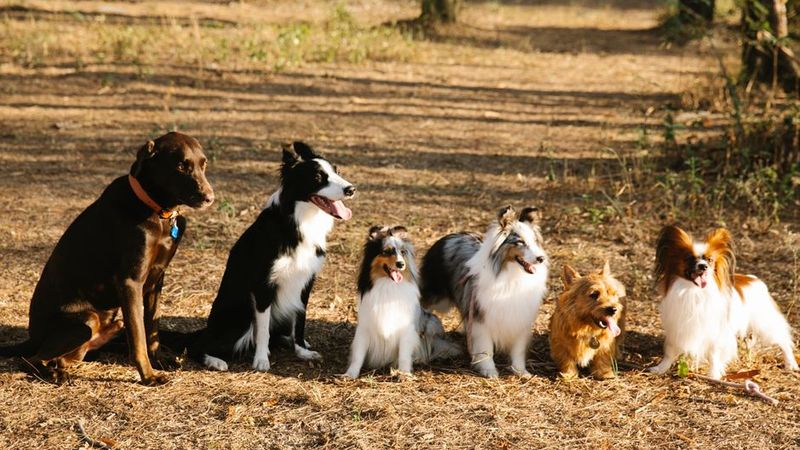
The American Kennel Club sorts every one of its recognized breeds into one of seven groups: Sporting, Hound, Working, Terrier, Toy, Non-Sporting, and Herding. It looks like a filing system for dog shows, and partly it is. But the groups started as something more practical: a way to sort dogs by the job they were bred to do, long before anyone cared about ring presentation.
That history is still useful today, because a breed's original job tends to predict its personality at home. A dog bred to point at birds for six hours a day does not turn into a couch ornament just because it moved into a condo. This article is a map of the seven groups and what unifies each one. If you want a full breakdown of any single group, including specific breed examples and daily-life tradeoffs, each group has its own dedicated guide.
Think of this as the table of contents, not the chapter.
Why Groups Exist: Job, Not Just Looks
Before dog shows existed, people bred dogs for work: retrieving downed birds, chasing rabbits by scent, pulling sleds, killing rats, guarding livestock. When kennel clubs formed in the late 1800s and early 1900s, they needed a way to organize breeds for competition, and grouping by original function was the obvious choice. A Beagle and a Greyhound look nothing alike, but both are Hounds because both were bred to chase game, just by different methods.
This matters for a buyer because the grouping is a shortcut to temperament and needs, not a cosmetic label. Two breeds in the same group, even if they look unrelated, often share real traits: how much exercise they want, how vocal they are, how independent they act during training. Two breeds that look similar but sit in different groups, like a Chihuahua (Toy) and a Jack Russell Terrier (Terrier, under UKC recognition), can behave in very different ways day to day.
The AKC updates group assignments occasionally as new breeds are recognized, but the seven-group structure itself has stayed stable for decades.
Sporting Group: Built to Work With a Hunter
Sporting breeds were bred to help hunters find and retrieve game birds, working closely alongside a person rather than independently. Retrievers fetch; pointers and setters find birds and freeze to mark their location; spaniels flush birds from cover. Examples include the Labrador Retriever, Golden Retriever, Brittany, and Vizsla.
At home, this group tends to be friendly, trainable, and eager to please, because cooperation with a handler was the whole point of the job. The tradeoff is exercise. Most Sporting breeds were bred to work full days in the field, so a short walk around the block rarely satisfies them. Owners who want a biddable dog but underestimate the exercise requirement often end up with a bored, overweight, or destructive adult dog.
Hound Group: Chasing by Scent or by Sight
Hounds were bred to chase game independently, without needing constant direction from a handler, which splits into two very different styles. Scent hounds like the Beagle, Basset Hound, and Dachshund track by nose and can struggle to let go of a trail once they pick one up. Sighthounds like the Greyhound, Whippet, and Rhodesian Ridgeback hunt by sight and speed, sprinting hard in short bursts, then resting for hours.
Both styles share one practical consequence: recall can be unreliable once a Hound locks onto a scent or a moving target, so secure fencing matters more than it does for most other groups. Temperament otherwise varies a lot across the group, from the Beagle's social, vocal energy to the Greyhound's surprisingly calm indoor manner.
Working Group: Size and a Serious Job
The Working group covers breeds bred for physical labor: guarding property, pulling sleds, rescuing people from water or snow, or hauling carts. This is where most of the largest breeds live, including the Great Dane, Saint Bernard, Newfoundland, and Bernese Mountain Dog, alongside guardian breeds like the Rottweiler, Doberman Pinscher, and Akita.
Because the original jobs varied so much, so does temperament within the group. Sled dogs like the Siberian Husky tend to be independent and high-energy. Guardian breeds tend to be more reserved with strangers and benefit from early, structured socialization. What almost all Working breeds share is size, strength, and a need for an owner who can handle serious training and space requirements, since a large, under-trained dog is a much bigger problem than a small one.
Terrier Group: Built to Hunt Vermin Underground
Terriers were bred to hunt and kill rats, foxes, and other vermin, often by digging them out of burrows. That job demanded a dog that could think and act independently, without waiting for instructions from a person standing twenty feet away. Examples include the Airedale Terrier, West Highland White Terrier, Scottish Terrier, and Miniature Schnauzer.
That independence shows up at home as a strong prey drive, a tendency to dig, and a stubborn streak during training that can surprise first-time owners expecting a small dog to be easy. Terriers are often confident, alert, and vocal, and many were never bred to tolerate rough handling from small children the way some Sporting or Working breeds were.
Toy Group: Small Size, Real Needs
The Toy group exists almost entirely around companionship rather than a working task, which is why it includes some of the smallest AKC breeds: the Chihuahua, Pomeranian, Shih Tzu, Yorkshire Terrier, and Cavalier King Charles Spaniel. Small size is the unifying trait, not temperament, since the group spans everything from the Cavalier's easygoing nature to the Chihuahua's intense attachment to one person.
The common mistake with this group is assuming small means low-maintenance. Many Toy breeds need daily training and socialization just as much as larger dogs, and several, like the Yorkshire Terrier and Shih Tzu, carry heavy grooming demands despite their size.
Non-Sporting and Herding: The Catch-All and the Instinct-Driven
The Non-Sporting group is the AKC's catch-all: breeds that do not share one single original job the way the other groups do. The Bulldog, French Bulldog, Standard Poodle, Dalmatian, and Chow Chow all sit here, and their histories range from companionship to carriage-running to water retrieving. There is no one trait that unites them beyond not fitting cleanly elsewhere.
The Herding group, by contrast, is built entirely around one instinct: moving livestock by circling, chasing, or nipping at heels. The Border Collie, Australian Shepherd, German Shepherd Dog, and Pembroke Welsh Corgi all carry this instinct, and it does not disappear just because a dog has never seen a sheep. In households without livestock, that instinct often redirects toward children, joggers, cars, or other pets, which is one of the most common reasons Herding breeds end up labeled as difficult rather than simply under-stimulated.
Using the Groups When You're Choosing a Dog
The table below is a quick reference for what each group tends to signal about daily life. It is a starting point, not a guarantee, since individual dogs vary within every group.
| Group | Original job | Common household signal |
|---|---|---|
| Sporting | Retrieving, pointing, flushing birds | Friendly, trainable, needs real daily exercise |
| Hound | Tracking or chasing game | Strong prey drive, recall can be unreliable |
| Working | Guarding, hauling, rescue | Large size, needs training and space |
| Terrier | Hunting vermin, digging | Independent, high prey drive, can be stubborn |
| Toy | Companionship | Small size, but still needs training and grooming |
| Non-Sporting | Varies widely, no single job | Temperament varies breed to breed |
| Herding | Moving livestock | High instinct to chase, circle, or nip; needs mental work |
If you're weighing a few specific breeds against each other rather than a whole group, you can compare breeds side by side to see how their individual traits stack up rather than relying on group averages alone.
Common mistakes
- Assuming every breed in a group behaves identically; group traits are tendencies, not guarantees for an individual dog.
- Picking a Sporting or Herding breed for its friendly reputation while ignoring its exercise or mental-stimulation needs.
- Treating small Toy breeds as low-maintenance when many need just as much training and more grooming than larger dogs.
- Expecting Hound breeds to have reliable off-leash recall once they catch a scent or see fast movement.
- Forgetting that Herding instinct shows up in houses with no livestock at all, often directed at kids, joggers, or other pets.
Frequently asked questions
How many breed groups does the AKC recognize?
Seven: Sporting, Hound, Working, Terrier, Toy, Non-Sporting, and Herding. Every AKC-recognized breed is assigned to one of these groups.
Are the groups based on appearance or job?
Originally and still primarily on job. Breeds in the same group were often bred for similar original work, such as retrieving, guarding, or herding, even when they look very different from each other.
Can a breed change groups?
It can happen, though rarely, usually when the AKC reclassifies a breed to better reflect its history or as new breeds are added. The core seven-group structure has stayed stable for a long time.
Does group membership predict a dog's personality?
It predicts tendencies, not certainties. A breed's group points to likely exercise needs, independence, and prey drive, but individual dogs vary, and training and environment matter too.
Which group should I look at first if I live in an apartment?
There's no single answer, since apartment fit depends on exercise needs and barking tendency more than group alone. Many Toy breeds adapt well, but some vocal Toy and Terrier breeds need noise management, while some Non-Sporting breeds like the French Bulldog also adapt well despite their size.