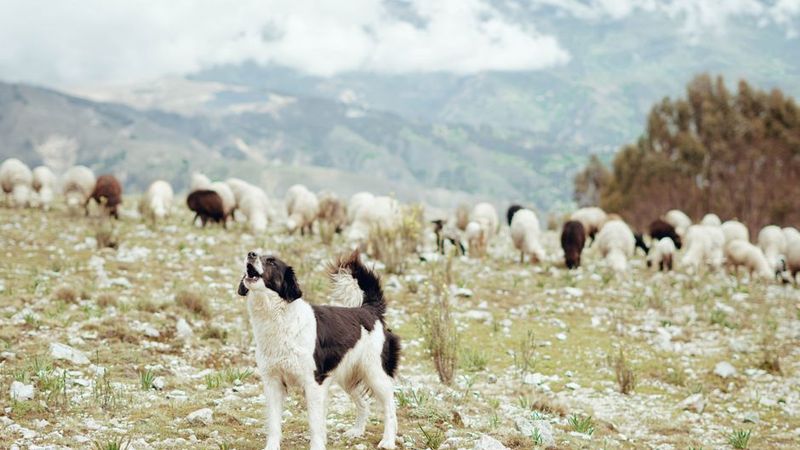
The AKC Herding group covers breeds bred to move livestock, mainly sheep and cattle, using a toolkit of instinctive behaviors: circling a flock, dropping into a low stalking posture, nipping at heels, and intensely tracking any movement at the edge of a group. The Border Collie, Australian Shepherd, German Shepherd Dog, and Pembroke Welsh Corgi are among the best-known examples, and all of them were bred for this specific skill set, even though their individual sizes and coats differ widely.
Almost none of these dogs today actually work livestock. They live in houses, apartments, and suburban yards. But the instinct that made them useful on a farm doesn't switch off just because the sheep are gone, which means herding behavior regularly redirects toward whatever is moving nearby: children running in a yard, joggers, cars, bicycles, or other household pets.
This article explains what that redirected instinct actually looks like day to day and how to work with it rather than against it.
The Core Herding Toolkit
Herding breeds use a specific set of behaviors to control livestock movement, and understanding them makes it much easier to recognize the same behaviors showing up at home. Circling is used to gather a flock and keep it together. A low, stalking crouch, borrowed from predatory stalking behavior but stopped short of an actual attack, is used to hold a flock's attention and direction. Nipping at heels is used to speed up or redirect animals that are moving too slowly or wandering off course.
Breed data notes this directly for the Border Collie, widely considered one of the most trainable breeds and bred to herd sheep by sight and instinct, and for the Australian Shepherd, whose entry states plainly that herding instinct can show up as nipping at heels or chasing children and cars. These aren't separate behavior problems from the breed's history; they're the exact same toolkit, just with no livestock to apply it to.
How It Shows Up Without Livestock
In a household with no sheep, the herding instinct still looks for something to organize. Running, screaming children are an especially common target, since fast, erratic movement closely resembles a scattering flock. A Herding breed may respond by circling the kids, nipping at ankles to try to gather them, or barking persistently until the movement stops. Joggers, cyclists, skateboarders, and cars are common triggers for the same chase-and-control instinct, which is part of why leash control matters more with this group than with calmer, lower-drive breeds.
Other pets in the house aren't exempt either. A Herding breed may try to control a cat's or another dog's movement through the house, pushing it into corners or blocking doorways, behavior that can look controlling or even aggressive to someone unfamiliar with the instinct but that's really just displaced herding behavior looking for an outlet.
Comparing Herding Breeds by Drive and Trainability
Herding drive and trainability vary across the group, which affects how intensely this instinct shows up and how easily it can be redirected through training. The table below compares several examples.
| Breed | Exercise (1-5) | Trainability (1-5) | Note |
|---|---|---|---|
| Border Collie | 5 | 5 | Needs both physical and mental work daily |
| Australian Shepherd | 5 | 5 | Eager for a daily task; nipping and chasing common without one |
| Belgian Malinois | 5 | 5 | Very high drive; not suited to a sedentary household |
| German Shepherd Dog | 5 | 5 | Versatile; needs structured exercise to avoid boredom behavior |
| Collie | 4 | 4 | Gentle and devoted; moderate herding drive |
| Pembroke Welsh Corgi | 4 | 4 | Short legs, but athletic and alert, with a vocal personality |
| Old English Sheepdog | 3 | 3 | Lower drive; easygoing nature despite herding background |
The Border Collie, Australian Shepherd, Belgian Malinois, and German Shepherd Dog sit at the highest end of both scales, which means their herding instinct tends to surface more often and more intensely without a job or structured outlet than it does in a lower-drive breed like the Old English Sheepdog.
Giving the Instinct a Legitimate Outlet
The most effective way to manage herding behavior is rarely to suppress it outright. It's to give it a legitimate job that satisfies the same instinct in a controlled way. Structured activities like agility, flyball, treibball (herding large balls instead of livestock), or even organized herding trials with actual sheep for breeds like the Border Collie and Australian Shepherd give the dog a real outlet for its drive to control movement.
At home, simple routines help too: a consistent daily walk or run, obedience training sessions that use the dog's mental sharpness, and games like fetch or tug that channel chase instinct into something safe. A Herding breed with no job and no outlet is far more likely to invent its own, usually by herding the family instead.
A Worked Example: The Backyard Nipping Problem
Consider an Australian Shepherd in a yard with two young children running around during play. The dog starts circling the kids, occasionally darting in to nip at their ankles or the backs of their legs. The children find this frightening or exciting, which amps up their running, which in turn amps up the dog's circling and nipping. Without intervention, this cycle tends to escalate rather than resolve on its own.
The more effective response is not punishing the dog mid-behavior, which can confuse a dog that's acting on strong instinct rather than defiance. It's interrupting the pattern early: calling the dog away calmly before the chase intensifies, redirecting its energy into a structured game, and separately teaching children not to run in circles or scream when the dog is nearby, since that movement pattern is exactly what triggers the instinct. Consistency over several weeks, not a single correction, is what typically resolves this pattern.
Who Thrives With a Herding Breed
Herding breeds suit owners who want an active partnership with their dog, not just a pet that sits quietly at home. People involved in dog sports, farm or rural life, or daily structured training routines tend to get the most out of this group's intelligence and drive. Households with small children benefit from understanding the nipping and chasing instinct upfront, rather than being caught off guard by it later.
If you're deciding between a high-drive Herding breed like the Belgian Malinois and a lower-drive one like the Old English Sheepdog, you can compare breeds side by side to see exactly how far apart their exercise and trainability needs really are before committing to either one.
Common mistakes
- Mistaking herding-driven nipping or circling for aggression, when it's usually displaced instinct looking for an outlet.
- Letting children run and scream near a high-drive Herding breed without supervision, which can intensify chase and nip behavior.
- Choosing a high-drive breed like the Border Collie or Belgian Malinois for a sedentary household with no plan for daily mental and physical work.
- Punishing herding behavior mid-chase instead of interrupting and redirecting the pattern earlier and more calmly.
- Assuming all Herding breeds have the same drive level; the Old English Sheepdog is far lower-key than the Border Collie or German Shepherd Dog.
Frequently asked questions
What breeds are in the AKC Herding group?
Examples include the Border Collie, Australian Shepherd, German Shepherd Dog, Pembroke Welsh Corgi, Collie, Old English Sheepdog, and Belgian Malinois, all bred to move livestock using sight, instinct, and close handler coordination.
Why does my Herding dog nip at ankles?
Nipping at heels is a natural herding behavior used to move livestock along. Without livestock, this instinct often redirects toward children, joggers, or other fast-moving targets.
Is herding instinct a training problem I can fix?
It's an inherited instinct, not a flaw, so it's better managed than eliminated. Structured exercise, obedience training, and activities like agility or treibball give the instinct a legitimate outlet.
Are all Herding breeds high-energy?
Most are, but drive varies. The Border Collie, Australian Shepherd, and Belgian Malinois sit at the highest end, while breeds like the Old English Sheepdog have a noticeably more easygoing daily energy level.
Are Herding breeds good with kids?
Many are affectionate and loyal, but supervision matters, since herding instinct can lead to chasing or nipping during active, noisy play. Teaching kids not to run in circles or scream near the dog reduces this trigger.