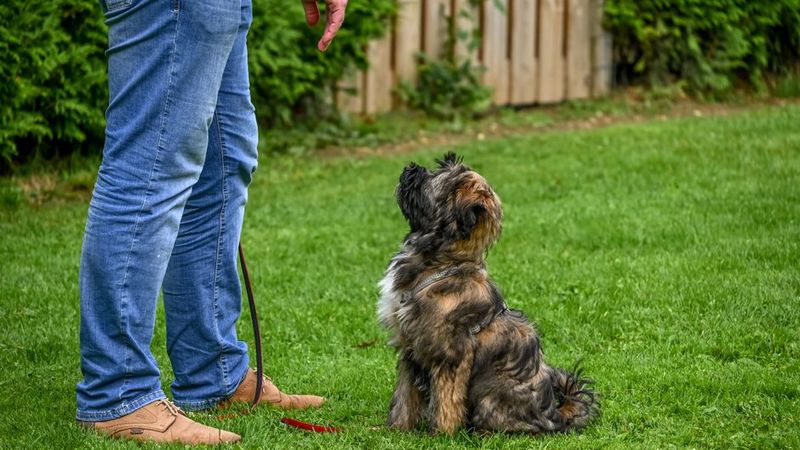
A small set of cues covers most of what a dog actually needs for everyday life and safety: sit, stay, come, leave it, and drop it. These five show up constantly, at the door, on walks, around dropped food, and in moments where a reliable response actually matters, like a dog about to pick up something dangerous.
Each cue below gets a short, practical teaching method rather than a long explanation of training theory, which is covered separately. These methods assume basic familiarity with reward-based training: marking the right behavior immediately and rewarding it, then building up gradually from an easy version of the skill to a more distracting, real-world version.
Sit
Sit is usually the first cue taught because it's physically easy for most dogs and builds an early sense of success for both ends of the leash. It also becomes the default position for a lot of everyday requests, like waiting at the door or greeting a guest calmly.
- Hold a treat close to the dog's nose, then move your hand up and slightly back over its head.
- As the dog's head tilts up to follow the treat, its back end naturally lowers toward the ground.
- The instant the dog's rear touches the ground, mark the moment and reward.
- Repeat several times, then start saying "sit" right as the dog begins to lower, eventually saying it right before the hand motion.
- Fade the hand motion gradually until the word alone gets the response.
Most dogs pick up sit within a handful of short sessions. If a dog struggles with the luring motion, rewarding it for sitting on its own, whenever it happens to do so naturally, and adding the word at that moment works as an alternative approach.
Stay
Stay builds on sit (or down) by adding duration and distance, and it's one of the cues dogs most often perform inconsistently, usually because owners move too fast through the stages of difficulty. It's genuinely useful for safety, like keeping a dog from bolting out an open door.
- Ask for a sit, then reward for holding the position for just one or two seconds before releasing with a consistent word like "okay."
- Gradually increase duration in small steps, a few seconds at a time, rather than jumping from two seconds to thirty.
- Once duration is solid, add distance by taking one small step back before returning to reward, increasing the distance gradually.
- Only combine longer duration and greater distance once each has been practiced separately; combining both too soon is the most common reason stay falls apart.
- Practice the release word consistently, so the dog learns that staying means waiting specifically for that word, not simply until it gets bored.
Come (Recall)
A reliable recall is arguably the most safety-critical cue on this list, since it's what brings a dog back from a dangerous situation, like heading toward a street or another animal. It's also one of the easiest cues to accidentally weaken, because many owners only call their dog to end something fun, like a trip to the park, which teaches the dog that coming when called ends good things.
- Start in a low-distraction space, like indoors or a fenced yard, with the dog on a long leash for safety.
- Say the dog's name and the cue ("Rex, come") in an upbeat tone, then take a step or two backward to encourage movement toward you.
- Reward enthusiastically the instant the dog reaches you, every single time in the early stages.
- Practice frequently in low-stakes moments unrelated to ending playtime, so the cue doesn't become associated only with fun stopping.
- Gradually add distance and distraction, always keeping the dog on a long leash until recall is reliable in a given setting.
Never call a dog to you for something unpleasant, like a nail trim it dislikes or a scolding, since this teaches the dog that coming when called is sometimes a trap, which undermines the cue everywhere else.
Leave It
Leave it tells a dog to disengage from something in its environment, whether that's dropped food, a dangerous object, or another animal it's fixated on. It's a cue built around resisting impulse, which makes it harder for some dogs than sit or come, particularly breeds with strong food drive or prey drive.
| Stage | What to do |
|---|---|
| 1. Closed fist | Hold a treat in a closed fist; wait for the dog to stop sniffing or pawing at it, then reward from your other hand. |
| 2. Open palm | Repeat with an open palm holding the treat; reward from the other hand when the dog looks away rather than going for it. |
| 3. On the floor | Place a treat on the floor, covering it with your hand if the dog goes for it; reward from your other hand for disengaging. |
| 4. Add the word | Introduce "leave it" right as the dog is about to disengage, then gradually say it earlier in the sequence. |
| 5. Real-world practice | Practice with lower-value items first, building up to higher-value distractions like dropped food on a walk. |
Drop It
Drop it is distinct from leave it: leave it prevents a dog from engaging with something in the first place, while drop it asks a dog to release something already in its mouth. Both matter, but drop it is especially important for a dog that tends to pick things up before an owner can intervene.
- Offer a trade: present a treat (or a more desirable toy) near the dog's nose while it's holding an object.
- As the dog opens its mouth to take the treat, the held object drops; mark the moment the item leaves the dog's mouth.
- Reward, then return the original object if it's safe to do so, which teaches the dog that dropping something doesn't always mean losing it permanently.
- Add the word "drop it" right as the trade happens, gradually introducing it earlier in the sequence.
- Practice regularly with toys during play, not just in moments when the dog has something it shouldn't, so the cue is well-rehearsed before it's needed for something risky.
A dog that only hears "drop it" when it's about to lose something valuable, with nothing ever returned, can start resisting the cue over time. Trading up, and giving an item back when appropriate, keeps the response reliable.
Keeping Cues Reliable Over Time
A cue a dog knows in a quiet living room isn't automatically a cue it will perform at a busy park, and skipping that gap is why many dogs seem to "forget" training they clearly know. Practicing each cue across a range of settings, distances, and distraction levels, rather than considering it finished once it works at home, is what makes these five cues hold up when they're actually needed.
Trainability varies somewhat by breed, which can affect how many repetitions a given dog needs to reach reliability, something worth factoring in if you're still deciding on a breed and want to compare breeds side by side on trainability and related traits. Regardless of breed, consistent short practice sessions spread across different environments get every dog further than occasional long sessions in just one place.
Common mistakes
- Jumping from a two-second stay to a thirty-second stay in one step instead of increasing duration gradually.
- Only calling a dog to end something fun, like playtime, which weakens the recall cue over time.
- Calling a dog to you for something unpleasant, teaching it that coming when called is sometimes a trap.
- Never giving an item back after "drop it," which can make a dog start resisting the cue.
- Practicing every cue only at home and assuming it will automatically transfer to busier, more distracting settings.
Frequently asked questions
What order should I teach these cues in?
Sit is usually easiest to start with, followed by stay, then leave it and drop it, with recall practiced consistently throughout since it benefits from early and frequent repetition in low-stakes situations.
Why does my dog know sit but ignore me outside?
A cue learned in a quiet space doesn't automatically transfer to a distracting environment. Practicing the same cue gradually across more challenging settings closes that gap.
What's the difference between leave it and drop it?
Leave it asks a dog to avoid engaging with something in the first place, while drop it asks a dog to release something already in its mouth. Both are useful and worth teaching separately.
My dog won't come when called anymore. What happened?
This often happens when recall has mostly been used to end fun activities or has occasionally led to something unpleasant. Practicing recall frequently in neutral, low-stakes moments and always rewarding it well can rebuild reliability.
How many training sessions does it take to learn a new cue?
It varies by dog and by cue, but most dogs show initial progress on a simple cue like sit within a handful of short sessions, while cues involving duration or impulse control, like stay or leave it, typically take longer and more varied practice.